Wednesday, June 24, 2015

The Years by Nicholas DelBanco

O.K., complaint number one is that this book was misrepresented to me as a nice book about old people going on cruises.


And there were a few pages about life on a cruise ship, probably just enough in the beginning to entice people to buy the book.  But the real message of the book was about the horror of memory loss as old age sets in.  It was also about the mental confusion that potentially leads one off on strange pathways when one is old, because the mind’s logic circuits have been compromised.

O.K., again.

Both my sister and I (60’s) read innumerable books about the process of dealing with aging parents (80’s); these were effectively self-help books.  And we read every one we could stomach.  Many did help. 


This was not a self-help book for the young-ens.  It was a baying at the moon from one of the young-ens, who loved his or her mother and family and wanted to rail against the injustice of facing the same fate.

Son or Daughter, it doesn’t matter, you spend the quality time at the end of life with a parent and scream at the unfairness of their loss of memory because you are next, and you know it. 

O.K., yet again, I sympathize with their loss.  But writing as the God-like omniscient narrator for the first 200+ pages of a 300 page book is inexcusable.  I hate O.N. because:

      Whatever the writer says is unassailably true, even if the author is lying or ignorant.

      O.N., but nonetheless single-sourced; no dialog second-source confirmation.

      It’s too easy – it’s the lazy writer’s mode.  You should work for it through dialogue.

I hate to bring in the name-dropping.  The fact that in this “kind of book”, all the women graduated from Radcliff and the men from Harvard.  They all summered in … .. and wintered in … ..  It used to be called old money and had sex appeal in women’s magazines, 50 years ago.  It was pretentious in this book: “bad champagne in business class”, Kubrick and Garbo.  It’s back to the Garrison Keilor quotation, “All the women are strong; the men good looking, and all the children are above average.”

There’re 24 million people over 65 and more than half of them are women.  This crass book will appeal to them.  It mentions the names they grew up with, signifying wealth, position and status.  If ten percent of these dowagers buy the book, that’s a million copies.  These millions also have really great moms who are dying in their nineties.  Women whose marriages lasted 50-70 years, who went through seriously trying times: world wars and depressions, and yet held their families together.


Saturday, June 20, 2015

My Struggle by

This book seems so committed.  Book 1 of 6?

Ruby by Cynthia Bond


I don’t normally stop and take notes when reading a book.  I like to base my opinions on the book’s overall impression.  However I’m changing my style to accommodate an aural-only discussion format. 

I’ve been impressed by three stylistically brilliant passages:
n                                The scene which unfolds in Chapter 4 with the town’s men gathered around a pit fire is a steal from Henry V’s night before Agincourt.  No better complement than to use a scene from Shakespeare.
n                                I love the start of Chapter 5 where Bond switches voices to that of the crow, which turns out to be a continuing theme.

n                                A literal bodice-ripper, this one.  Page 98 has Ruby with the best orgasmic scene that I can remember for sheer thunder.  This is repeated at the end of Chapter 13 with Bond’s equivalent fantasy of a male orgasm.
My two criticisms are:

n   The first is one of timing.  This “Ruby” book is effectively a rewrite of Zora Neale Hurston’s, 1937 “Their Eyes Were Watching God,” which I read this year during Black History Month. 

n   The whole book is a female fantasy novel.  The last quarter of the book was not just predictable, but procedural.  Bond’s depiction of dropping to a new low below low is a script-writer’s wet dream.  There are many books like this one that fall into the lusty lure of film adaptation and forego literacy for lucre.  The script scenes are evocative.  By the end, we have forgotten Shakespeare and Greenwich Village and are wallowing in America’s pig sty of “HBO’s Deadwood – 2004-06”.
 
Not black or white female, it could be Chinese or Muslim, as well, but female.  The homage paid to Hurston wasn’t just in the Black village setting, and the return home and salvation, but most importantly in the eye-opening learning about the world around them, and the striving, against inhuman odds and travesties, of all women, for their rightful place in it.

Saturday, June 13, 2015

The Stranger by Harlan Coben


I read it in three sessions over a 24 hour period.

It’s a great, spell-binding read.  I’m not going to spoil the action, so I’ll only hint at the plotlines.

A perfect suburban family in a charming soccer mom town on the east coast has their dream interrupted by a stranger who comes into their lives briefly dropping a bombshell.  He causes suspicion, which turns into mystery.

The writing is the type I enjoy, cerebral thought development, and the pace of plot development is what keeps you reading the next chapter without pause.  The protagonist is the husband/father who has two boys, and it’s mostly men in the story.  The author after all is male.

An added lure is the involvement of crazy WEB sites like www.HowToFakeAPregnancy.com

Thursday, June 4, 2015

All The Light We Cannot See by Anthony Doerr


I thoroughly enjoyed reading this book.  It wasn’t the passionate read of six-hour sessions because you just can’t put it down.  So I’m asking myself the question, “Why was it so good?”  It’s not just me, many other readers whose opinion I value thought it was a “best recent read”.

Of course there was the dramatic crescendo of the ending and since that was at the end it sticks with us.  You couldn’t help but shed a tear, even though it was a predictable ending.

I think we are in a new era of writing about the last century.

In the era surrounding WW-II, the 30’s, 40-s, and 50’s there was the John Gunther type of book Inside Europe, a study of the politics of nations, winding up with William Shirer’s, Rise and Fall of the Third Reich.  Next came the good guys, bad guys’ era with John Wayne heroes.  We’ve just finished a quarter century of le Carré type espionage and spy novels where the whole cast ensemble are bad guys; there are no good guys.  Now they’ve all died off. 

We have entered the era of retrospectives on 20th century history: no politics, no heroes or villains.  It is pleasant reading.  It is stories about little people, commoners.  That is why I think this book has such broad appeal.  Now to some of the specifics:

·           Doerr’s style of multiple scene slices by time and venue was brilliantly handled.  For me, it was just the right mixture.  I think that the shortness of the shifts, 1-3 pages, helped to make this work.

·           Characterization achieved efficient balance.  There was no glut of minor characters; they conveniently crossed the stage and exited.  But we got to know and understand the children.  Werner was deeply-layered and natural; possible based on the author himself.  Making him an orphan was a good literary device; no need to delve into parentage.  The girl, Marie-Laure, is endearing because of her perseverance, but painted through the reflected visions of her father and grand-uncle.  The blindness was a perfect device for her, because, like a magic trick, it diverted attention away from the author going too deeply into a teenage girl’s character.  Another thing that makes these characters work is the ages: a ten year story, from 6 to 16.

·           There is the illusion of minute detail on any number of subjects in the children’s lives.  We readers don’t really want this to be a text on radio electronics, nor tide pool crustacean life.  But we like to think we have learned something and we enjoy the detail writing about things that stir passions like puzzles, museums, and Jules Verne.

·           I theorize that we are now in an age of a kinder, gentler world view of the last century.  I could make similar comments about the author, Phillip Kerr, who has written ten novels following the career of Bernie Gunther over thirty years (1930-1960) from Berlin police Lieutenant to private eye.

Tuesday, May 26, 2015

Confessions of a Sociopath by M.E. Thomas


Depressing  --  Negative  --  If one wasn’t a self-diagnosed Sociopath, it would lead to suicidal thoughts.  This book was dull, boring and somewhat useless, … possibly even pointless.

There was no question in the 40’s; sociopaths were shunned at best.  50 years later, at the turn of the century, America was the land of GREED, survival of the fittest.  She, the author, hasn’t changed – the tenor of society around her has changed; society now loves her.  She’s a Tea-Party icon.

I look at these sorts of books as merely a secondary income stream of people on the speaker’s circuit.  I’m sure she makes a lot of money on lecture tours, but she needs some sort of creditability which the book gives her.

This book should not be touted as non-fiction -- and she doesn’t; others do though.  She leaves any categorization out of the cover and title page: no “novel”, or “memoir”, or even “fictional memoir”, which might be closer to what it really is.  She, and I can’t say Thomas since that is a pseudo name, uses the word “Confessions”, which implies memoir; and she calls it a memoir as the first line of the book; then continues in the succeeding sentence to cut away the underpinnings of many things that are memoir: anonymously written?, invented memories?, and narrative discretion?.  She pompously psychoanalyses her parents and her childhood with no medical background to back up her analysis.

The major flaw in her hypothesis lies in trying to identify sociopathy as a genetic trait, somewhat like the X-chromosome controversy raging in the world of genetic research about homosexuality.  Unfortunately she is not presenting research results, merely anecdotal vignettes, and hinting that her parents made her do it.  Her vignettes are cute and fun, but meaningless.  All her stuff about school years high jinx could equally be attributed to her being a bully and a “mean girl”.  She liked the “power” of driving a car as a teenager? Duh, so do most teenagers.  She hated her father as a teenager, double Duh.

Her exploits were trivial; maybe even the acceptable side of sociopathy: “She’s heartless, but we love her”, “He doesn’t understand me, but I still love him”, “She’ll stab you in the back, but she’s brilliant with clients”.  I think the author has stretched her story a bit too far to equating herself with the rebel-like, bad-boy James Dean. 

The family story around me was that my 1-year-old baby sister “fell” out the second story window, when I was 3, but was it psychotic or sibling-rivalry?  One of my teen age incidents involved my short football career.  I was the littlest guy on the team, but a ferocious middle-linebacker with a license to stop anyone going to our goal.  My coach was profuse in his joy when I angled across the field at an escaped, opposing half-back; hit him mid-thigh; and drove him through the sideline bench; leaving his leg at an odd angle.  I loved the adulation and the feel of the hit.  Psychotically vicious temperament or football mania?


Tuesday, April 28, 2015

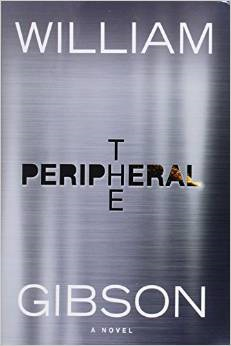
The Peripheral by William Gibson


I am so happy that I have finished reading the new (Oct 2014) William Gibson book, “The Peripheral”. 

Science-Fiction was a genre that I grew up with, and now authors like Heinlein (Mars) and Azimov (Robots) have grown and gone.  The past decade or two, I have looked to Gibson to stretch my mind 20 years out:

Pattern Recognition (2005) was about the coming massive impact of computers’ ability to predict future events; he delved into flash mobs controlling public opinion.  Zero History (2011) recognized that retail sales would become dominated by computer companies: Yahoo, Amazon, and Google.  It was a subtle prediction, but real.

Mankind has sought ways to avoid death probably since we recognized we were sentient: theology was an easy way; mummification a little harder; the fountain of youth in more scientific times; Sci-Fi offers tantalizing possibilities as in Pohl’s “HeeChee Saga”.

In “The Peripheral”, Gibson is doing his normal examination of where technology is headed, extending three areas ahead for a few decades: drones, nanotechnology, and 3D-printers.  But he’s also tempted to flirt with immortality of sorts with a glimpse into communications technology that can span time, or to be more exact alternate universes. 

Instant communication is speculative but considered a possibility if we aren’t hindered by our perceived 4-dimensional space-time constraints.

I’m a decent techie reader, but I was totally lost for the first 50 pages; then I had only a glimmer over the next 50 of what was happening.  I love this challenge.  Now at page 120 (of 482), I got it.

“We’ll need to buy specialized printers in the stub,” Lev said.  “This will be beyond what they usually work with.”
“Printers?”
“We’re sending files for printing an autonomic cutout,” said Lev.
“Flynne? When?”
“As soon as possible.  This one will do?”
“I suppose,” said Netherton.
“She’s coming with us then. They’ll deliver the support equipment.”
“Equipment?”
“She doesn’t have a digestive tract. Neither eats nor excretes.  Has to be infused with nutrient every twelve hours.  And Dominika wouldn’t like her at all, so she’ll be staying with you, in grandfather’s yacht.”
“Infused?”
“Ash can deal with that.  She likes outmoded technology.”
Netherton took a drink of gin, regretting the addition of tonic and ice.
The peripheral was looking at him.