Sunday, September 29, 2019

Peter’s Folly – Phase II


I’ve arrived at the mid-point, I guess.  Basic construction is complete, but many of the finer details I will address this winter.  This construction is a cat staircase, nothing more nor less.

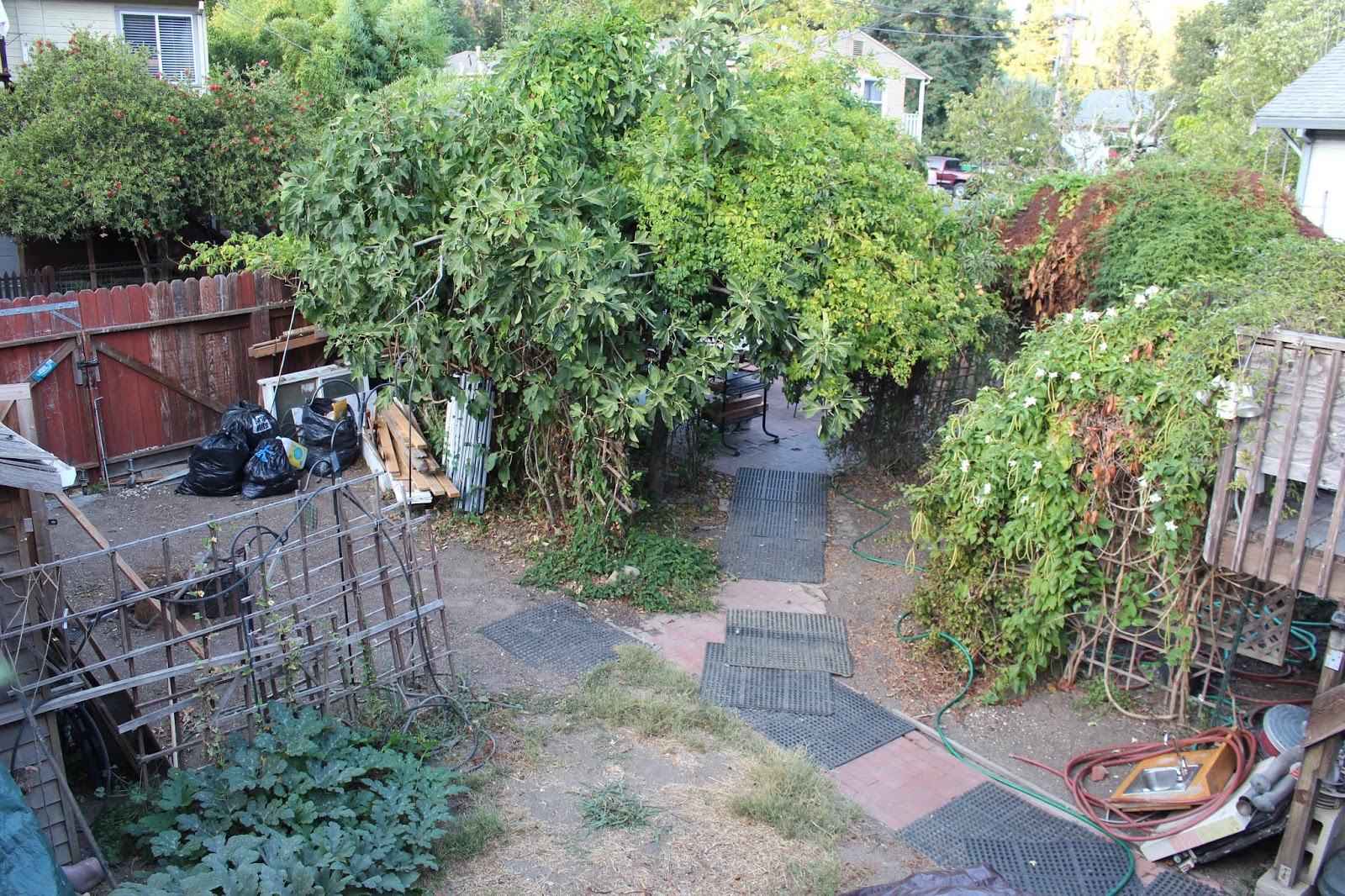
The design of the spiral staircase blends well with the raised garden cabinets used for vines in my backyard area.  There are three stair step levels, and then three landings – two for the cat and the highest one is my bedroom/breakfast balcony floor.
That first jump is over 2-1/2 feet and the next almost two feet as well.  Big jumps, even for a cat, but I can always add a small platform.  These platforms are made of soft redwood fencing boards.  Their texture is rough and uneven, perfect for cat-scratching and clawing; also good for helping the climb up the staircase.  There is a flower bed planter box along side the stairs, with a trellis going up one side.
For the cat, step two provides a view of the narrow passage between my house and my neighbor’s.  There’s the cover of the trellis vine to watch the bird feeders along the fence line.

Or, saying goodbye to the neighbor’s house, the cat can jump to level three, which affords the initial view of y backyard.  This is a nice resting spot after having done three big jumps.  A backward reflection on what a climb we have made is shown next, looking down, which people say we should never do.  Nonetheless, it provides perspective.
The steps are necessary in their own right.  It’s not just to get to the landing decks for wonderful cat views of the world.  I’ve always hated cat doors (others come in unwanted).  An I won’t put up with lengthy, midnight arguments about nocturnal freedom.  So, my solution is the deck off my bedroom, which has French doors that I leave open 99% of the time. 
If the raccoons can make it to my bedroom deck, then cats can do so as well.  But I’ve made it easier for them with the stairs, and a lot more pleasant with the two special lounging cat decks/landings.  You can see on the left that the Sun Deck will be a bright and spacious area for enjoying the backyard vista.
Of course, the best view is from the Observation Deck, one more landing up.  It isn’t as roomy as the Sun Deck, which also has rain protection.  Even though cramped, I already know that Peppermint Pattie, the cat in question, loves the views from each of my highest windows: back yard, side yard, and front. 
She is currently awaiting a surgery (of a private nature), and when the healing from that is done [Halloween ?], we will have a grand opening.
2-legged friends are restricted to the very top deck, which is my bedroom balcony.

This construction work has been labelled, “Peter’s Folly”.  Not just because it’s for a 6-month old kitten, but also because the whims of all cats are capricious.  It may never be used, but that is the prime characteristic of “Folly’s”.  The second reason for the “Folly” nomenclature is that while photographing the “contraption” from my normal deck, I was loathe to notice that that there was only a two-foot difference in height between the two decks, across a span of a dozen feet.  I could have laid a 1” X 12” twelve-foot board across the span, which would have allowed the cat to quite happily use the back porch steps and then cross the gulch on the pine board bridge, suitably outfitted with guard rails.

Saturday, September 28, 2019

Wonderland IV


One, of two items, that I will comment on to close out Summer 2019 in Monte Rio is today’s Wonderland stage production at Michael Tabib’s Russian River Hall.
This is the third calendar year Rhian Millar & Paul Dubray have done one of their periodic Russian River documentaries.   They locally stage a variety show to exhibit the talents of an “in- focus” River town.  They record the sound for a later broadcast on KRCB radio and edit a video; for I assume, an eventual Russian River documentary – that is Rhian’s profession.
It was a sentimental performance for me today.  Nostalgia for me watching many of my KGGV radio peers participating in a talent review: Damien Olsen co-MC-ing with Paul; Sadie Damascus doing her Laughing Lady schtick; Pat Nolan & Gail King reading poetry. 

This all in a venue 100 meters away, and me sitting in a small section surrounded by luminaries: Dan Fein, Ann Erickson, Cynthia Strecker, Jane Kleimo, and John Schubert.  This was a turnout of Monte Rio’s Who’s Who.


Saturday, September 7, 2019

Library Stewardship


Posted: 06 Sep 2019 03:28 PM PDT
I've written in many places about one of the key shifts in librarianship. We are moving from being library-centric to being community-centric. This movement is based on two core ideas: first, that libraries will perform better when they understand the environment in which they operate; and second, that true advocacy is about solving problems together, about helping to build an agenda for the community, then helping to get it done. Libraries that make their communities stronger get stronger support from the community.

So how can directors systematically inform themselves about community players and issues in the first year, especially in a new town? (Assistant Directors moving up within the same organization might have a handle on this, or might not.)

I propose a method that can be personal or institutional. Either approach begins the same way: work up a list of community movers and shakers. Who are the influencers in your community? When you're still new to a place, finding that information may seem hard. But a simple exercise, conducted once with staff, once with the board, quickly generates 40-50 names. The exercise is this: as you think about these broad areas of the community, who makes a difference? The categories are in alphabetical order.
§ Business. Who are the main employers, or activists within the business community?
§ Civic. Every community has civic groups like Rotary, Optimists, or the Lions.
§ Education. Who are the prominent leaders--principals, superintendents, communication directors--in the community?
§ Elected. Who are the key elected officials?
§ Faith-based. Who are the leaders of some of the larger or influential churches, synogogues, mosques, or other houses of worship?
§ Government. Who are the non-elected, or appointed officials who get things done?
§ Media. Some of my most enlightening interviews have been with people who do interviews.
§ Non-profit. There are many, many not-for-profit groups, often with deep expertise about various issues.
The second step is to interview them. If done on a personal basis, call them up, at least one a week, with maybe two weeks off in a year. That's at least 50 people a year. Schedule two a week and you can meet 50 people in six months. Introduce yourself and say that you're the new director, and would like to pick their brains about community issues. I recommend having that discussion either in their office, or on neutral ground, like a restaurant. Some directors bring lunch-for-two with them to the interviewee's office. (If being done on an institutional basis, I recommend sending two reference librarians out to conduct an in-depth reference interview at the person's place of business. Obviously, this is more formal.)
What do you talk about with them? These three questions, with probing, will easily get you through an hour lunch:
1.   As you think about your constituencies (and getting clarity about those constituencies is part of the probing), what issues do you think they will be most concerned about over the next 18-24 months?
2.   What decisions do you think your constituents need to make over the next 18-24 months, and what do you wish you knew before those decisions?
3.   Who else should I talk to?
The third step: Make notes. If done on a personal basis, I think it's enough to keep the information in your contact database. What is their contact information (preferred name, email, phone, full titles, etc.)? When did you meet with them (and who paid after you pay the first time)? What did they tell you about their family, or hobbies? What were their answers to your interview? What immediate upcoming project are they working on (that maybe you need to track)? I also recommend calling this out on your calendar: "community interviews (or CI or whatever tag that makes sense to you), with the person's name. Together, contacts and calendar can provide a searchable record of the process.

If done on an institutional basis--as the beginning of a planning process, for instance--this note-taking should take place on a more formal, shared, internal tool: a relational database, a blog, a series of staff debriefs.

Fourth and finally, stay in touch. Depending on the other demands on your time, it's probably wise to book a follow-up meeting, no more than six months from the first, and preferably quarterly. This gives you a chance to report back on your own progress, and to ask follow-up questions. Staying in touch might also be noticing community news that matters to that person. For instance, an interviewee might mention an upcoming fundraiser; after seeing that the event was successful, the director might send a congratulatory email or phone call.

This staying in touch not only keeps you out of the bubble (where you only hear what you already know or believe), it might also lay the groundwork for lifelong friendships.

Taken together, this approach for the first year director accomplishes three purposes:
1.   It builds relationships with the powerful. You will know their name and interests. They will know yours. (Be prepared to share, succinctly, your own personal information and institutional issues. But this is more about listening than talking.)
2.   It orients you to community issues. Most people  do not seek that, and even more rarely, do so systematically. Be forewarned: If you thoughtfully interview 50 movers and shakers, you're liable to become one.
3.   It lays the ground work for significant institutional contributions to the community. There is both an opportunity and a threat here. The opportunity is that you just might find an issue that the library can significantly assist with. The threat is that you might find so many that it's overwhelming. Then the task, institutionally, is to pick a project that not only really helps the community, but deeply aligns with library values, direction, and expertise.
The bottom line is this: public library directors cannot be successful if they don't know their communities. And building a network of contacts and supporters is a shrewd investment of time that might be useful in many circumstances (funding crises, intellectual freedom challenges, or simply identifying potential partners ).


Saturday, August 31, 2019

I am an Anglophile


I have just started watching “The Criterion Collection”, a four-film set entitled, “David Lean Directs Noel Coward”.  I started with “Brief Encounter”.  Besides a perfect remastering of the original film, Criterion has added special features of most of the people involved, talking about the film, the production, and the people involved.  That is what makes the difference between just watching the movie and almost studying it.
I want to hold back on watching, for my first time, the next three.  I’m hoping to find like-minded people, who can watch the special features, either before or after the film [vote] and will have the time to discuss the film.  The next three in the collection are: “Blithe Spirit”, “This Happy Breed”, and “In Which We Serve”.   I want to do “Brief Encounter” again, at the end – it is England’s best picture ever.
We could do these over four weeks, on a specific night; or two days in a row; or over a weekend.  Meals, snacks, wine, popcorn, guests all in the mix.

I am a self-confessed, avowed Anglophile – no denials.  I acquired this affliction on my summer-tour of Europe in 1960, between my 4th and 5th year at University [Arizona] – I was not a bright student.
Landing in London for the first time in my life was awe-inspiring – hearing the mother-tongue a revelation.  Jet-lagged, I got up at 4am that first day and rode the tube all over town, stopping at an early am fish market, and then a bulk vegetable purveyor, ate “things” – winding up in some suburb where I stole a glass bottle of milk and a newspaper, and back at the hotel for the 9am tourist breakfast, but having seen and heard a glimpse of Dickens.
In my 5th year [2 required courses], one I took was a fun course in British WW-I poets: Owen, Sassoon, and Brooke.  This graduate, expert’s class was for MFAs in English – the instructor told me she would not grade me, but I would get an “A” if I spoke my mind.   I did – “Goodbye, Mr. Chips” still makes me cry.
The clincher to my Anglophilic tendencies, however, was spending six years, mid-eighties, as an ex-pat, living and working in non-London England.  Half those years I was single, and the other half married, to an out of (above) my class English woman, who was a brilliant, Cambridge graduate (in English).
Some people of my age group yearn for those rock and roll times of Elvis, the Beatles, and smooth jazz, of their teens, which may have been their best times.  My memorable era was this eighties period in England, where I underwent another growth spurt.  So, I still associate “Hitchhikers Guide” (radio), and “Smiley’s People” (TV) with England.
Now that I am beginning to try and put together a regular weekly film viewing group, I am letting show my natural predilection towards British film, and I’m looking for ways to support a sub group of like-minded people, that might like-wise be willing to watch more than one British film a year.

Thursday, August 29, 2019

A Quiet Day


Well today was supposed to be a quiet, restful day.  Yesterday I packed up a sixth of a cord of Walnut scraps at Calico, then unloaded them at home; cut up most of them with a reciprocating saw; and finally carried the pieces up (30-40 loads) my eighteen back steps, to my winter storage site on my back deck.  Four hours manual labor in the hot sun took me down to 173.4 pounds, as I advanced to my goal of 169 for my 63rd high school reunion next month.
So, my goal for today was to pick up meds at Kaiser, and while at it, I scheduled my annual review for Sept 13th, blood tests next week.  I picked up a 3 cubic foot (90 pounds) bag of Happy Frog soil amendment, and a new Jasmine vine from Harmony Farms, so I’d have something outside to do in the afternoon.  I was going to get in some reading for my book clubs.  [and hem up a 3rd apron for my sink cover].
When much to my bewilderment, when I went to install the new Jasmine, I found that the the entire next three sections, 12-feet of fence line, had fallen, bottom to top 7 feet, into my neighbor’s yard.  This was going to be future work, section by section, probably into next year.  I wasn’t ready for this.  But as I assessed the damage, the neighbors couldn’t get to their garbage can, and other things.
From 2-4, I hedge-trimmed, shears-cut, and hauled sections of hedge to my driveway.  I did it in three sections, each 7’ X 3’ X 4’.  Correy can finish them up – into bags, then the dump.  It was hot, sweaty work, and when I took a shower at 4 pm and weighed myself, it was a recent low at 170.2.  Of course, I drank a lot of fluids and ate a steak dinner, but still, I’m a solid 173, after dinner and re-hydrating.
During all this frenzied activity, by me, my neighbor's gnome-cat watched with total aplomb.  I made noise, stirred activity, but like Lewis Carroll's cat, she just grinned.

OK, the weight thing is cultural – no one who hasn’t seen me in fifty years will know or care whether I weigh 169 or 181.  It is nice however, going back to my annual checkup above.  I was 190 in 2016 and 180 in 2018, getting to 170 in 2019 is a positive trend.  I did this in 2017 and the numbers came out great.


Tuesday, August 20, 2019

Horny Flowers


    The Horniest form,
   possibly the Sexiest:
earth life that we know

_ _ _ _ _ _ _ _ __ _ _ _ _ _ _ _ _ _ _
 I water my planter box garden
Each afternoon at 3:30.  The garden
Loves bees and other bugs.

 In book club today, we spoke of
Trees and other flora.

 I watched the drooping sun,
Wine glass in hand,
As a black butterfly, small bee,
then a monster bumble bee
ravage, in succession, this delicate
lavender flower.  She enjoyed it.

It dawned on me that whether one believes in a Religious God, or a scientific god, all life has a purpose, interwoven with all other life.

The more I listen to NPR’s “Science Friday” and/or read books, the more I believe that all life forms enjoy sex.

The bee with the Passion Flower, burrows deep into the center core.
A mating long and happily sought.

Saturday, August 3, 2019

My Kaiser Doctor was right


(I am a slow learner)
As we all know, I am averse to taking any kind of pain medication or drugs of any kind.  However, over the past few years, I have found that my muscle recovery time from bouts of strenuous activity has been taking longer and longer.
This past Thursday, I spent the day with a dozen fifty-pound bags of dirt of various sorts: first loading them in the car, then unloading them to my backyard; then opening and adding them to my new garden cabinet.  In total, that meant lifting a ton of dirt.  The day before I built the new cabinet: measuring, cutting, drilling, screwing; wielding tools and wood; and clearing the area (hedge-trimming) for the new cabinet.  The day before that, I loaded and unloaded the car with a load of walnut wood from Calico, climbing in the 10-foot high scrap pile; selecting armfuls of pieces; filling the back of the car with about a yard of fireplace-sized pieces – about 600 pounds.
When I was younger, my muscles would bounce back the next day.  No Longer!  By yesterday, end of week Friday, I was sore allover: back-ache, leg ache, and arm ache.  These past few years, it has taken me days, weeks to recover.  When I have complained to my Kaiser Doctor about this problem, she said, “Take an aspirin”.
So last night I did – one 200-mg Advil PM.
My lifestyle isn’t going to change – I’ll be as active forever.
But I’m going to add that one 200-mg Advil PM tablet to most of my Friday night’s regimens in place of the 81-mg aspirin.
I took the day off today, partially because I was feeling so good this morning: arms strong, legs bouncy, and no lower back pain.  A good night’s pain-free sleep did the trick.
I even have them around only for a situation, probably once a month or two, where I know I’m going to have a problem sleeping.